AI Filmmaking vs Traditional Production in India: When Each One Actually Wins
Every brand conversation about video in India now includes the same question somewhere in the first ten minutes: “Can this be done with AI?” Sometimes it’s asked hopefully, by a marketing head with a shrinking budget. Sometimes it’s asked nervously, by someone who’s read that AI production can cut costs by 40-70% and isn’t sure what that means for quality.
We run both workflows in-house – traditional cinematography with directors and DOPs, and AI-assisted production with dedicated prompt engineers on our team – so this isn’t a hype piece for one side or a defensive piece for the other. Here’s the honest breakdown of where each one wins.
What “AI filmmaking” actually means in 2026
AI filmmaking doesn’t mean typing a sentence and getting a finished ad. In practice, it means AI tools are used at one or more stages of production:
- Scripting and storyboarding – faster iteration on concepts before committing budget to a shoot
- Visual generation – creating scenes, environments, or B-roll that would be expensive or impossible to shoot practically
- Character and avatar animation – mapping performance onto animated or synthetic characters
- Voiceover and multilingual dubbing – generating natural-sounding voiceovers across multiple Indian languages from a single script
- Reframing and format expansion – turning one aspect ratio into several (a 16:9 hero film into 9:16 reels) without a full reshoot
- Post-production acceleration – colour, compositing, and rendering pipelines that used to depend entirely on editor availability
None of this replaces a director. It changes what a director spends their time doing.
Where AI filmmaking genuinely wins
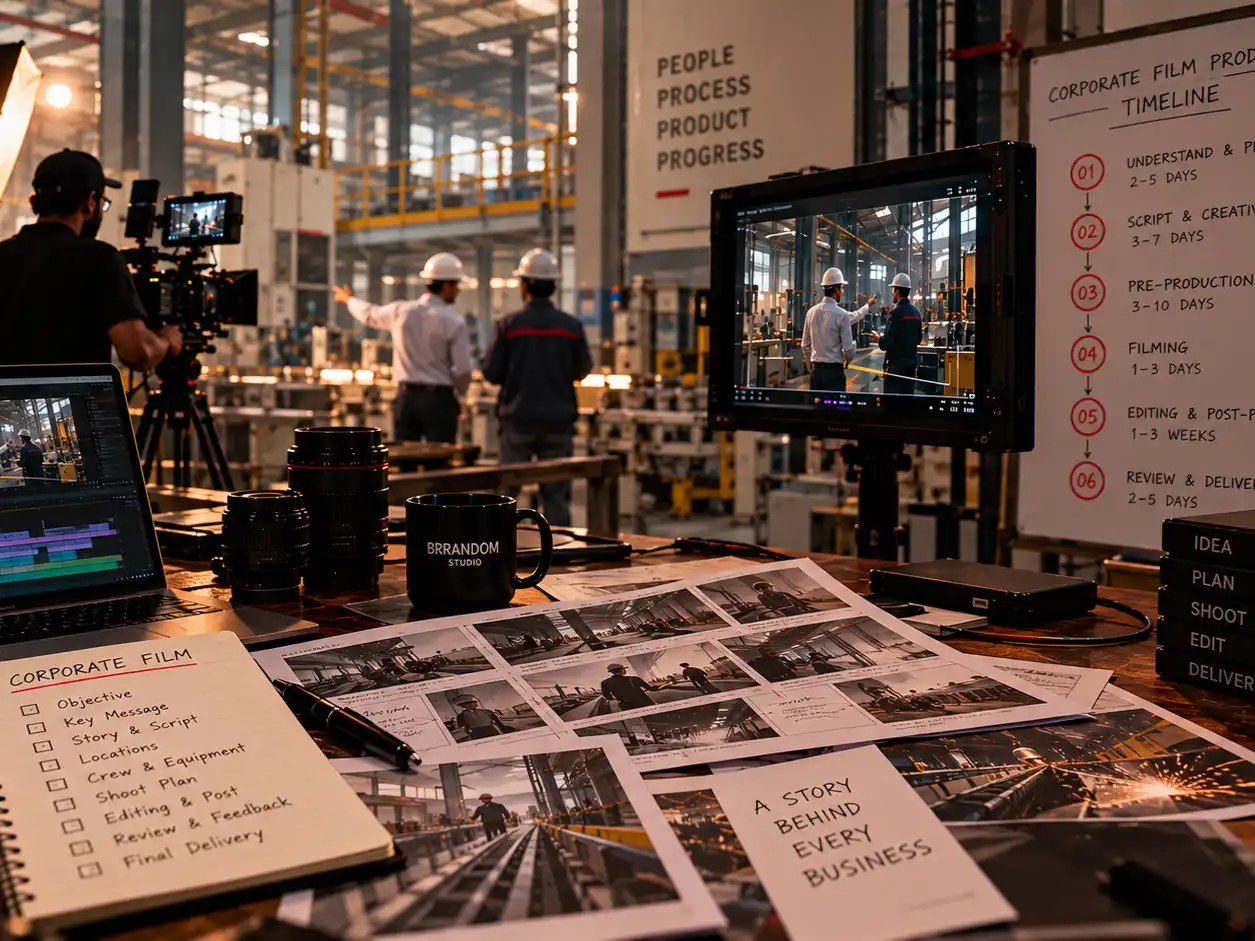
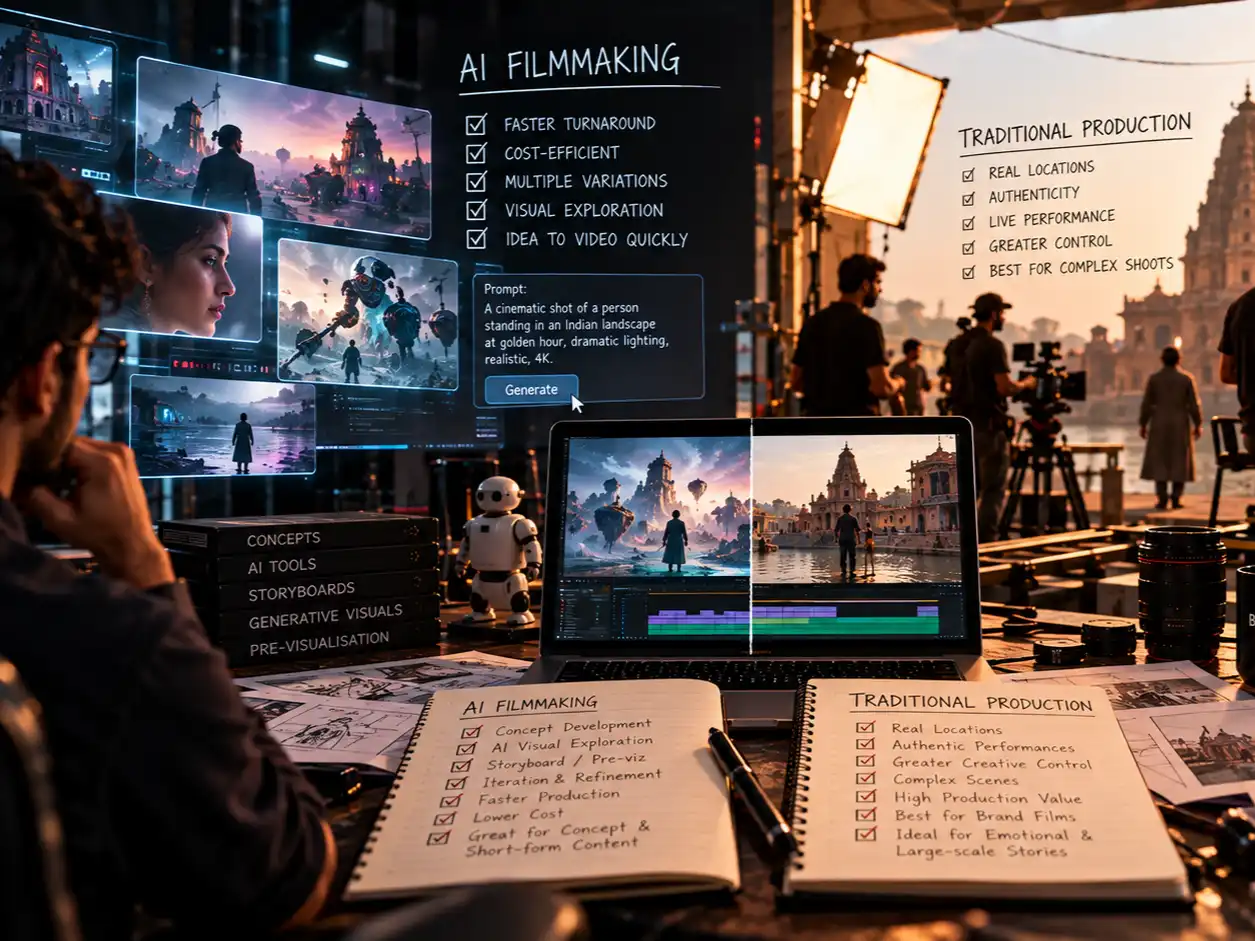
Speed. A traditional corporate or brand film typically takes 4-8 weeks from brief to delivery. An AI-assisted production can often move in 1-3 weeks, because weather, location availability, and cast scheduling stop being bottlenecks.
Multilingual scale. If a brand needs the same message in 8-10 Indian languages, reshooting with local talent in each market can cost multiples of the original production. AI-generated voiceover and lip-sync can deliver language variants from a single master shoot at a fraction of that cost.
High-volume, lower-stakes content. Social media ad variants, quick product explainers, and internal training content don’t need the full weight of a live shoot every time. This is where AI production is close to a pure win on cost and speed.
Visuals that would be impractical to shoot practically. A slow-motion product visual that would require an unrealistic set build, or a fantasy/conceptual sequence with no real-world equivalent, is often cheaper and faster to generate than to shoot and composite traditionally.
Where traditional production still wins – and will for a while
Anything built on real human performance. A testimonial film, a founder’s story, a hospital patient’s experience – these depend on the specific, unrepeatable truth of a real person’s face and voice. AI can enhance the edit around that footage; it can’t replace the footage itself without the film losing its credibility.
Brand categories built on trust and authenticity. Healthcare, financial services, and anything involving a real customer’s real experience carries risk if the audience senses synthetic performance where they expect a real one. We’ve seen this directly in our own healthcare and industrial client work – the moment a viewer suspects a testimonial isn’t real, the entire film’s credibility collapses, regardless of production quality.
Complex, layered storytelling. A brand film built around narrative tension, pacing, and a director’s specific eye for a shot is still a fundamentally human craft. AI tools can accelerate parts of the pipeline, but the creative decisions that make a story land emotionally still come from a person who understands story structure – not a prompt.
Anything where the “how it was made” is part of the brand story. Legacy brands, heritage campaigns, and craftsmanship-led categories often lean into the fact that a real crew, on a real location, made this film – and that authenticity is part of the message.
The honest answer: most strong campaigns now use both
The brands getting the best results in 2026 aren’t choosing AI or traditional production – they’re using AI to expand what a single traditional shoot can produce. A brand film shot once, properly, with a real director and real cast, can be reframed into a dozen formats, dubbed into multiple languages, and extended with AI-generated B-roll – all without reshooting.
That’s a meaningfully different question than “AI or traditional?” It’s: what should be shot for real, and what should be extended, adapted, or scaled using AI once it exists?
What to actually ask a studio before you commit
- Who directs the creative decisions – a person, or the tool? AI is only as good as the creative direction shaping it.
- What happens to quality control when something needs a revision? Fast production means nothing if a fix takes three weeks.
- Can they show real client work across both traditional and AI-assisted production, not just one or the other?
- Do they understand brand accuracy – tone, colour systems, typography – well enough to keep AI-generated content on-brand at scale?
How Brrandom works across both
Our studio runs an in-house team of 55+ that includes directors, cinematographers, and dedicated prompt engineers working alongside each other, not in separate departments handed off between vendors. That means a brief gets evaluated on its own terms – a hospital brand film for a client like Desun Hospital calls for real performance and real trust-building, while a multi-language product explainer or a fast-turnaround campaign variant might lean on AI-assisted production to hit scale and speed without inflating budget.
The question we ask first isn’t “AI or traditional” – it’s what the story needs to be believable, and what can be built faster once that foundation exists.
Talk to Brrandom Studio about your project →
FAQs
For high-volume, lower-stakes content and format variations, AI-assisted production can match or exceed traditional workflows on speed and cost. For content built on real human performance and trust – testimonials, healthcare, and brand storytelling – traditional production still delivers stronger, more credible results.
Depending on the project, AI-assisted production can run 40-70% lower than an equivalent traditional shoot, though the gap narrows for complex, brand-critical work that still requires significant human creative direction.
Not for brand-critical work. AI tools are only as effective as the creative direction behind them – a studio with experienced directors, writers, and strategists will consistently outperform AI output used without that oversight.
Multilingual voiceover variants, social media ad cutdowns, product explainers, internal training content, and visuals that would be impractical or expensive to shoot practically are strong fits for AI-assisted production.
With caution. These categories depend heavily on audience trust, and content that reads as synthetic where a real testimonial is expected can damage credibility. AI tools are better used here for post-production efficiency (multilingual dubbing, format variants) than for replacing real performance.
Recent Blogs